


Villa elevators are different from ordinary commercial elevators. They are not just about technology and safety but also carry your emotions and expectations for home. From spatial layout and design aesthetics to quiet operation and smart control, and then to installation details and after-sales support, every aspect requires professional and thoughtful consideration.
An excellent supplier should not only be a product provider but also your partner in realizing your home dreams. It will offer customized solutions and continue to provide reliable services for years or even decades to come.
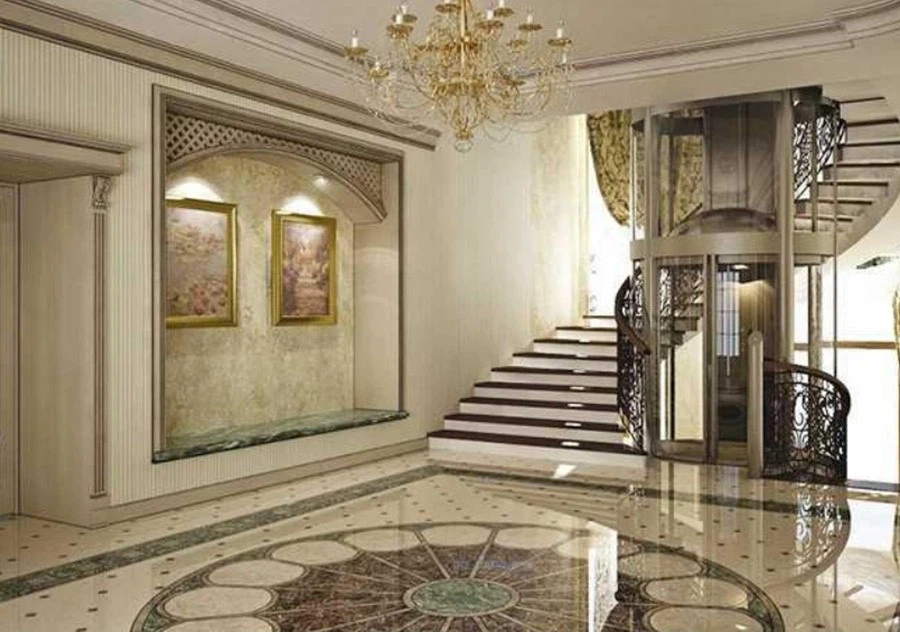
Ⅰ Demand Positioning: Clarifying Constraints
1.1 Space and Building Structure Adaptability
Shaft Conditions: Existing shafts require precise measurement of dimensions.width × depth × height. Flexible options like machine-room-less or full-view designs are available.
Floors and Load Capacity: Common villa elevators serve 2-4 floors with a load capacity of 250-630kg.
Installation Constraints: Older villas need evaluation of floor bearing capacity and wall structure to support screw-type or hydraulic installations.
1.2 User Groups and Humanistic Care
Accessibility Design: Wheelchair users require a car width of ≥1100mm and dual handrails. Elderly users need voice announcements and gentle start functions.
Child Safety: Door panels feature anti-pinch design. Emergency call buttons inside the car are positioned at heights suitable for multiple age groups.
1.3 Aesthetic Integration and Personalization
Style Consistency: Modern minimalist styles can opt for full-glass cars with metal frames. Classical styles suit solid wood veneers with carved elements.
Customization Flexibility: FUJI elevator offers 100+ material combinations. Such as etched glass and leather cladding. Customizable RGB lighting.
1.4 Smart Connectivity and Future Expansion
Basic Needs: Floor-specific stops and power-failure leveling.
Advanced Needs: Mobile app calling and facial recognition startup.

Ⅱ Global Supplier Evaluation System - In-Depth Analysis of 6 Dimensions
2.1 Safety Certification (Weight: 30%)
International Certifications: CE (EU). UL (North America) and GOST-R (Russian-speaking regions).
Safety Redundancy Design: Must include triple protection. Such as speed governors + safety gear + buffers.
2.2 Technical Route and Energy Efficiency Performance (Weight: 25%)
|
Drive Type |
Applicable Scenarios |
Pros and Cons Comparison |
|
Traction |
Mid-to-high-rise (≥3 floors) |
Smooth and energy-efficient |
|
Hydraulic Low-rise (2-3 floors) |
Powerful |
High electricity consumption and requires regular oil changes |
|
Screw |
Shaft-less renovations |
Small footprint. Slow speed (≤0.15m/s). Suitable for elderly residences. |
Energy Efficiency Standards: Prioritize products meeting the EU standard. It can reduce electricity consumption by 40%. FUJI elevator uses permanent magnet synchronous motors + energy feedback technology.
2.3 Customization Capability and Workmanship Quality (Weight: 20%)
Production System: Suppliers should have a certain production scale. Advanced production equipment. And a long-established elevator factory.
Workmanship Details: Car gap ≤2mm. Guide rail hardness ≥HB200. Door machine lifespan exceeding 500,000 cycles.
Design Support: Provide design dimension suggestions and custom designs. Along with corresponding drawings and installation and maintenance guidance. Subsequent spare parts.
2.4 Global Service Network (Weight: 15%)
After-sales Response: Promise quick technical response and on-site technical support as needed.
Spare Parts Supply: Quickly provide required spare parts throughout elevator's lifecycle.
2.5 Total Cost Analysis (Weight: 10%)
Initial Cost: Includes equipment. Transportation. Installation. Customs clearance fees.
Long-term Cost: Energy consumption. Maintenance (approximately 5% of equipment price annually). Spare part replacement cycles.

Ⅲ Risk Avoidance - 7 Major Pitfalls in Procurement
1. Low-Price Bidding Trap: Some workshop-style factories offer prices 30% lower but use second-hand guide rails and non-standard circuits. It may result in an accident rate three times higher than the industry average.
2. Technical Over-Packaging: For example, claiming a speed of 0.4m/s when it is actually only 0.3m/s.
3. After-sales Disconnection: Some brands sell through multiple layers of agents. If agent changes, it becomes impossible to find the manufacturer for after-sales support.
4. Insufficient Cultural Adaptation: eg, European suppliers may underestimate Asian families' demand for quietness (requiring ≤40 decibels).
5. Substandard Spare Parts and Reduced Lifespan: Using cheap guide rails instead of stainless steel. Using low-quality door machine systems.
6. Out of date technology and Compatibility Risks: Some brand elevators use outdated technologies with high failure rates. Such as traditional relay control. It is necessary to confirm the use of mainstream technologies. Such as permanent magnet synchronous traction machines and variable frequency control.
7. False Brand Promotion and OEM Traps: Some suppliers claim to be "European brands" but are actually small factories producing under OEM with immature technology.
Ⅳ Evaluation of Candidate Suppliers
1. Factory On-site Audit: Focus on inspecting the test tower and production line.
2. Existing Customer Undercover Visits: Inquire about actual failure rates and response speeds.
3. Test Ride Experience: Feel the operational comfort and noise level.

FUJI elevator company produces villa elevators for over 30 years.
We export to more than 80 countries. And 20+ years of elevator export experience.
Our elevators are high-quality and stylish.
They fit perfectly in villas and small spaces.
We offer competitive prices without cutting corners.
Trusted globally, built to last.
Contact us for a smooth, beautiful lift solution!